

You have read three different dates for appointing an e-invoicing provider, and your software vendor has a fourth opinion. Before you sign anything, check which dates are set in law and which are still commentary.
The short answer: Ministerial Decision No. 244 of 2025, as amended by Ministerial Decision No. 66 of 2026, sets the dates. A business whose Revenue "is equal to or exceeds AED 50,000,000 shall appoint an Accredited Service Provider by 30 October 2026 and shall implement the Electronic Invoicing System by 1 January 2027." Below that figure, the dates are 31 March 2027 and 1 July 2027. A top-band business that has not appointed an Accredited Service Provider by 30 October 2026 should ask the Ministry of Finance and a licensed tax adviser what applies. Government Entities appoint by 31 March 2027 and implement by 1 October 2027. A pilot and voluntary adoption start on 1 July 2026. Consumer sales are outside the system until the Minister decides otherwise.
This article covers the Ministry of Finance (MoF) e-invoicing rules as published on 20 September 2026. For access to government digital services, see UAE PASS for business.
The instruments that set the dates
An MoF news item dated 29 October 2024 states that the Tax Procedures amendment lets the Minister "issue the necessary decisions to implement the system, determine its effective dates". MoF announced Decisions 243 and 244 of 2025 on 29 September 2025.
| Instrument | What it does | Status note, as read on 20 September 2026 |
|---|---|---|
| Ministerial Decision No. 243 of 2025 | Scope, exclusions, duties of issuers and recipients | Comes into force "on the date of its publication" in the Official Gazette |
| Ministerial Decision No. 244 of 2025 | Pilot, voluntary adoption, appointment and implementation dates | Comes into force "on the date of its publication" |
| Ministerial Decision No. 66 of 2026 | Replaces Article 5(1)(a) of Decision No. 244, moving one date | Comes into force "from the day following its publication" in the Official Gazette |
| Cabinet Resolution No. (106) of 2025 | Administrative violations and fines | UAE Legislation portal: issued 09 Oct 2025, effective 15 Oct 2025, status "Active" |
The English PDF of Decision No. 66 of 2026 leaves its signature date blank; MoF announced it on 10 May 2026. We did not find its Official Gazette date on the MoF pages reviewed on 20 September 2026.
Federal Decree-Law No. 16 of 2024 amended the Value Added Tax law to fit the system. Article 65(5) of Federal Decree-Law No. 8 of 2017, in the consolidated text on the MoF site, states: "the Registrant subject to the Electronic Invoicing System must issue and transmit Tax Invoices in the form of an Electronic Invoice, in accordance with the Electronic Invoicing System." Article 70(4) applies the same rule to Tax Credit Notes. For the registration that makes a business a Registrant, see VAT registration in the UAE.
Which band your business falls in
Decision 244 defines Revenue as "The gross income earned by a Person during the most recent Accounting Period, based on the financial statements prepared in accordance with applicable legislation in the State or, if such financial statements are not available, based on other documentation acceptable to the Authority."
MoF material words the threshold differently:
- Decision No. 244 of 2025 and Decision No. 66 of 2026: "equal to or exceeds AED 50,000,000".
- MoF news of 10 May 2026: entities "whose annual revenues exceed AED 50 million".
- The timeline image on the MoF e-invoicing page: "Large and Major Companies (Revenue in AED from 50m and above)" and "Small and Medium Sized Companies (Revenue in AED up to 50m)".
If your gross income sits close to AED 50,000,000, ask MoF in writing which band applies and keep the reply.
Footnote 3 of the MoF timeline image states: "Revenue as per the latest financial statements. In the case of newly established company, it is based on the projected revenue for the ongoing financial year". Decision No. 244 of 2025, read on 20 September 2026, does not state that rule; it refers instead to "other documentation acceptable to the Authority" where financial statements are not available. A company without financial statements should ask MoF and the FTA which documents they will accept.
MoF material that still shows 31 July 2026
The MoF timeline image, uploaded under 2025/11, and the Guidelines V1.1, dated 01 June 2026, still show 31 July 2026 for the top band's provider appointment. Ministerial Decision No. 66 of 2026 sets 30 October 2026:
| Document | Date shown for appointing a provider (top band) | Date of the document |
|---|---|---|
| Ministerial Decision No. 66 of 2026 | "by 30 October 2026" | PDF file name dated 14 May 2026 |
| MoF news, targeted amendments | "from 31 July 2026 to 30 October 2026" | 10 May 2026 |
| MoF timeline image on the e-invoicing page | "31st July" | Uploaded under 2025/11 |
| UAE Electronic Invoicing Guidelines, Version 1.1, section 8.3 | "31st July 2026" | Cover date 01 June 2026 |
Decision No. 66 of 2026 states that Article 5(1)(a) "shall be replaced"; this article follows that decision. The same MoF news item adds that "the timeline for the commencement of mandatory implementation will remain unchanged", with implementation "by no later than 1 January 2027". If a document you rely on shows 31 July 2026, rely on the decision and confirm with MoF.
Decision No. 66 of 2026 replaced only paragraph (a); we found no changed dates for the other bands.
What is in scope, and what is not yet
Article 3 of Decision No. 243 of 2025 applies the system to "Any Person conducting Business in the State in respect of every Business Transaction, except where the Person or the Business Transaction is excluded under Article 4." MoF's announcement of 29 September 2025 describes the scope as "all business-to-business (B2B) and business-to-government (B2G) transactions", and the timeline image refers to "B2B, B2G and G2G eInvoice". Where they differ, ask MoF; this article follows the decision text.
Consumer sales. Article 5(2) of Decision No. 244 of 2025 states that "Business-to-Consumer Transactions shall not be subject to the Electronic Invoicing System". It continues: "any Person engaged exclusively in such transactions shall not be subject to the Electronic Invoicing System, until such time determined by a decision issued by the Minister." The decision defines a consumer transaction as one with "a recipient who is a natural person not carrying on Business." We did not find a decision setting a consumer date on the MoF pages reviewed on 20 September 2026.
Note the word "exclusively". A seller under an e-commerce trade licence in Dubai can list its buyers by type before assuming it is outside the system.
Exclusions in Article 4. Article 4 of Decision No. 243 of 2025 lists exclusions. They include business transactions by government entities "in a sovereign capacity, and which are not in competition with the private sector", certain international airline passenger services and certain VAT exempt or zero-rated financial services. One exclusion is time-limited: airline goods transport with an Airway Bill is excluded "only for a period of twenty-four (24) months from the date on which the Electronic Invoicing System becomes effective." Read the full article before treating any transaction as excluded.
How the system works: five corners and Peppol
The UAE Electronic Invoicing Guidelines, Version 1.1, dated 01 June 2026, describe five parties. The supplier is Corner 1, the supplier's Accredited Service Provider (ASP) is Corner 2, the buyer's ASP is Corner 3, the buyer is Corner 4 and the Federal Tax Authority (FTA) is Corner 5. The Guidelines state that "Electronic Invoices are issued, transmitted and received in XML format" and that "Peppol's PINT-AE billing specifications set out the specific contents."
The FTA's e-invoicing page states that "unstructured invoice formats such as PDF, Word documents, images, scanned copies and emails are not considered e-Invoices." The FTA page also names the Ministry of Finance portal as "The only official source of information related to the introduction of e-Invoicing in the UAE". MoF also publishes a "UAE Electronic Invoice Mandatory Fields" document, Version 1.0, dated 23 February 2026, to compare your invoice data against.
Onboarding. MoF's programme deck (file dated 30 June 2026) states: "Businesses can select and onboard with their preferred Accredited Service Provider (ASP) via EmaraTax." Article 5(3) of Decision No. 244 of 2025 requires compliance with "the onboarding process and all the technical requirements established by the Ministry and the Authority".
Choosing a provider: what MoF publishes
Article 5(2) of Decision No. 243 of 2025 states: "The list of the Accredited Service Providers shall be published by the Ministry." That list is on the MoF page "eInvoicing Accredited Service Providers (ASPs)", which states: "This list is updated periodically to include newly Accredited Service Providers." MoF's news on Decision No. 64 of 2025 states: "Only accredited service providers are authorised to offer eInvoicing services in the UAE".
The same page lists a second group of pre-approved providers "currently undergoing the final production assessment stage". It states that "Full Accreditation will be granted upon the successful completion of the remaining technical requirements and final approval by the Ministry of Finance." Check which group a provider sits in on the day you sign, and save a dated copy.
Article 5(1) of Decision No. 243 of 2025 places the appointment duty on "the Issuer and the Recipient, as applicable". Ask your adviser how that applies to you as a buyer.
Duties once you are live
Decision No. 243 of 2025 sets these operating rules, as read on 20 September 2026:
- Issue and transmit. Article 6 states that the invoices and credit notes it covers "must be issued and transmitted by the Issuer through the Electronic Invoicing System within 14 days from the Date of Business Transaction." The decision adds: "Where the Issuer is a Registrant, the Issuer shall issue and transmit the Electronic Invoice, and the Electronic Credit Note to the Recipient within the timeline prescribed by the VAT Law."
- Report to the FTA. The issuer and recipient "must report Electronic Invoices and Electronic Credit Notes issued...to the Authority within the timeline prescribed by the Minister." We did not find a decision prescribing that reporting timeline on the MoF pages reviewed on 20 September 2026.
- System failure. "Every Issuer and Recipient shall notify the Authority of a System Failure within 2 Business Days from the date of occurrence of the System Failure".
- Data changes. The issuer and recipient notify their ASP in writing of changes to data registered with the Authority "within five (5) Business Days from receiving confirmation of the amendment by the Authority."
The Guidelines add, in section 12.2: "HSN codes are currently optional. The timelines for making the HSN codes mandatory shall be announced in due course."
Fines under Cabinet Resolution No. (106) of 2025
The fines column quotes the MoF English text of the resolution; the violations are summarised except row 1. They refer to failures "within the timeline prescribed by the Minister".
| Violation (row 1 quoted; others summarised from the MoF text) | Fine, as the MoF text shows it |
|---|---|
| "Failure by the Issuer to implement the Electronic Invoicing System including the failure to appoint an Accredited Service Provider within the timeline prescribed by the Minister." | "AED 5,000 in case of delay for each month or part thereof." |
| Failure by the Issuer to issue and transmit an Electronic Invoice to the Recipient within the prescribed timeline | "AED 100 for each Electronic Invoice up to a maximum of AED 5,000 per calendar month." |
| Failure by the Issuer to issue and transmit an Electronic Credit Note within the prescribed timeline | "AED 100 for each Electronic Credit Note up to a maximum of AED 5,000 per calendar month." |
| Failure by the Issuer, or by the Recipient, to notify the Authority of a System Failure within the prescribed timeline | "AED 1,000 for each day of delay or part thereof." |
| Failure by the Issuer or the Recipient to notify the appointed ASP of changes to the data registered with the Authority | "AED 1,000 for each day of delay or part thereof." |
The English text on the UAE Legislation portal words the first row as "Failure of the Issuer to implement the Electronic Invoicing System, including failure to appoint an accredited service provider, within the timeline specified by the Minister." Its fine is "AED 5,000 (five thousand dirhams) for each month or part thereof of delay." The amounts agree, but the portal states the invoice cap "per Gregorian month", not "per calendar month". Ask MoF which wording applies. These are government fines, separate from any ASP charges or adviser fees, which this article does not state.
Three worked examples
A consultancy with AED 49.5 million in gross income. Against the decision's wording, the dates to check are 31 March 2027 and 1 July 2027. Its finance director asks MoF in writing, because the figure is close to the line.
A company set up this year. It has no financial statements yet. Decision No. 244 refers to "other documentation acceptable to the Authority" where statements are not available, and the MoF timeline footnote refers to "projected revenue for the ongoing financial year". It asks MoF and the FTA which documents they will accept before choosing its dates.
A shop selling only to walk-in consumers. Article 5(2) of Decision No. 244 covers a person "engaged exclusively" in consumer transactions. If the shop begins invoicing a company, it reviews its position with a licensed tax adviser.
Timeline and readiness checklist
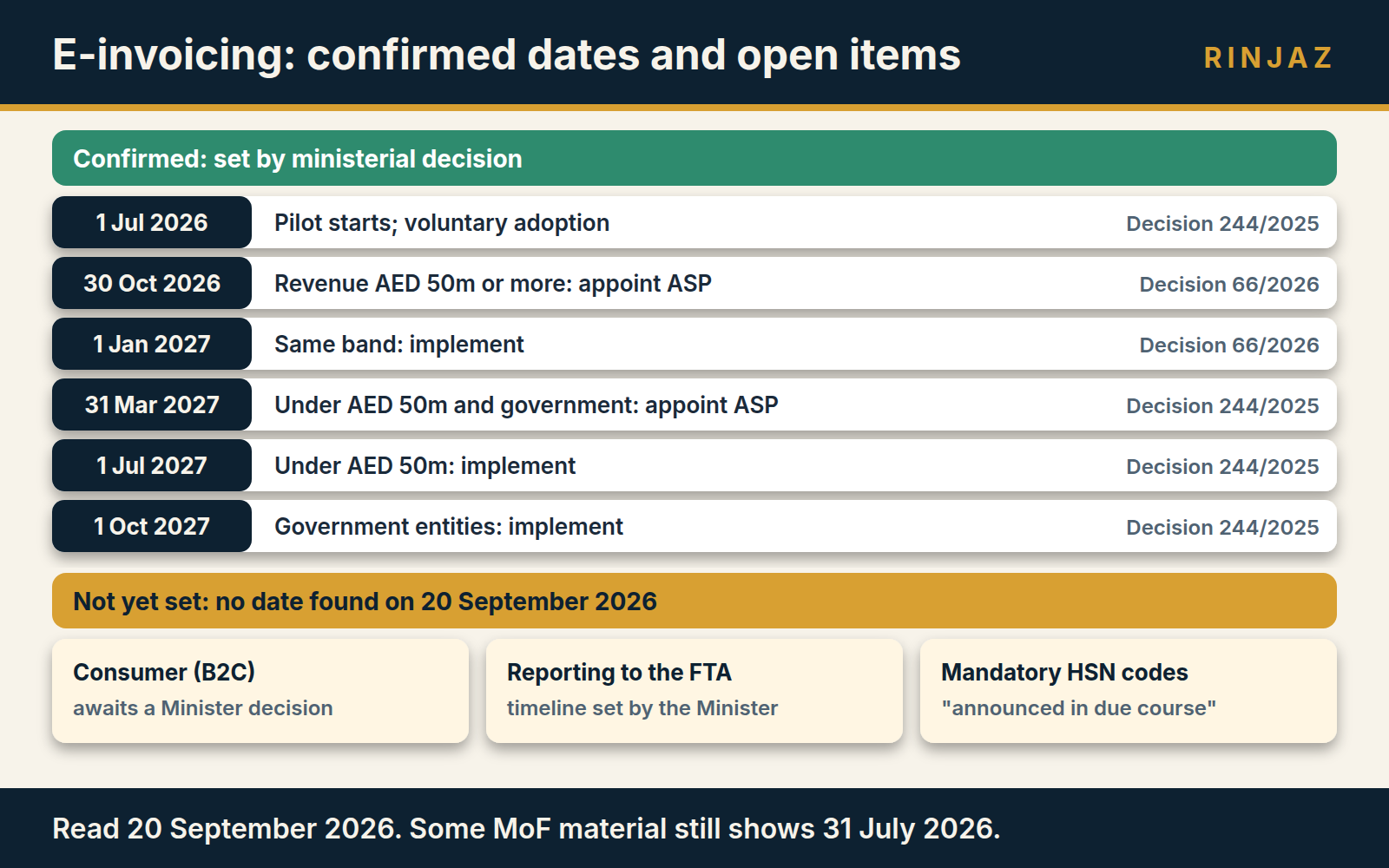
Practical asset: the e-invoicing timeline and readiness checklist. Part A separates dates set by an instrument from items not yet set; Part B is a checklist to date and sign off. It does not decide your position. Part A. Timeline, as read on 20 September 2026 | Item | Status | Date | Instrument | |---|---|---|---| | Pilot Programme starts | Confirmed | 1 July 2026 | Decision No. 244 of 2025, Art. 3 | | Voluntary adoption allowed | Confirmed | "as from 1 July 2026" | Decision No. 244 of 2025, Art. 4 | | Revenue "equal to or exceeds AED 50,000,000": appoint ASP | Confirmed | 30 October 2026 | Decision No. 66 of 2026, replacing Decision No. 244, Art. 5(1)(a) | | Same band: implement | Confirmed | 1 January 2027 | Decision No. 66 of 2026 | | Revenue "less than AED 50,000,000": appoint ASP | Confirmed | 31 March 2027 | Decision No. 244 of 2025, Art. 5(1)(b) | | Same band: implement | Confirmed | 1 July 2027 | Decision No. 244 of 2025, Art. 5(1)(b) | | Government Entity: appoint ASP | Confirmed | 31 March 2027 | Decision No. 244 of 2025, Art. 5(1)(c) | | Government Entity: implement | Confirmed | 1 October 2027 | Decision No. 244 of 2025, Art. 5(1)(c) | | Fines for violations | Confirmed | Effective 15 Oct 2025 (legislation portal) | Cabinet Resolution No. (106) of 2025 | | Consumer (B2C) transactions | Not yet set | None found | Awaiting "a decision issued by the Minister" | | Reporting e-invoices to the FTA | Not yet set | None found | Decision No. 243 of 2025 leaves it to "the timeline prescribed by the Minister" | | Mandatory HSN codes | Not yet set | None found | Guidelines 1.1: "announced in due course" | Part B. Readiness checklist 1. Latest financial statements pulled; gross income figure and accounting period written down. [ ] 2. Band chosen against the decision wording; written query sent to MoF if close to AED 50,000,000, newly established or without financial statements. [ ] 3. Your two dates copied from Part A into the finance calendar. [ ] 4. Transactions listed by buyer type: business, government, consumer only; Article 4 exclusions checked against the full text. [ ] 5. Provider status checked on the MoF ASP list on the day of signing (accredited or pre-approved); dated copy saved. [ ] 6. Onboarding route confirmed: provider selected via EmaraTax, as MoF's deck describes. [ ] 7. Invoice data compared with the Mandatory Fields document (Version 1.0) and PINT AE. [ ] 8. Credit note process included, not only invoices. [ ] 9. Written procedure for notifying a System Failure within 2 Business Days. [ ] 10. Written procedure for telling the ASP about registered data changes within five Business Days. [ ] 11. PDF and emailed invoices mapped for replacement by structured e-invoices. [ ] 12. Named owner to check the MoF e-invoicing page for new decisions on B2C, reporting and HSN codes. [ ]
Date each answer; keep the statements, MoF reply and appointment record. Treat the "Not yet set" rows as open until an instrument sets a date.
Who decides, what you prepare, what a provider can do
What the authority decides. The Minister sets the timelines by ministerial decision, and the authorities, not any provider, decide how the rules and fines apply to your business. MoF accredits service providers and publishes the list. The FTA is Corner 5 under the Guidelines.
What the business prepares. The revenue evidence, the transaction map, the provider appointment, clean invoice data, and the procedures in Part B. E-invoicing sits alongside other tax and company duties; see the overview of UAE corporate tax, corporate tax registration in the UAE and UBO and economic substance filings.
What a provider can do. MoF states that only accredited service providers may offer e-invoicing services. A business services provider that is not accredited may, within whatever its licensed activity covers and where MoF's rules allow, help assemble documents and track correspondence. No provider can set your band or change a date.
RINJAZ is not a licensed tax adviser. This article describes published requirements. Obtain advice from a licensed UAE tax adviser before acting.
Last verified: 20 September 2026. Information verified against official sources on 20 September 2026. Fees checked on 20 September 2026.
If you are preparing documents for e-invoicing readiness, contact RINJAZ to confirm availability, scope and quotation. RINJAZ is a privately licensed UAE service provider. It is not a government entity and does not act for any authority.
A provider's role, within whatever its licensed activity covers, is to prepare documents, submit them through the correct channel and track progress. The Ministry of Finance and the Federal Tax Authority decide how the e-invoicing rules apply, and no provider can promise the outcome.
Clear answers, without the clutter
Has the deadline to appoint an e-invoicing provider changed for large businesses?
Which revenue figure decides the band for UAE e-invoicing?
Do UAE businesses have to issue e-invoices to consumers?
Is a PDF invoice sent by email an e-invoice in the UAE?
What is the fine for not appointing an Accredited Service Provider on time?
When must e-invoices be reported to the Federal Tax Authority?
Official sources
Primary government and institutional references used to verify this guide. Open any source in a new tab for the current authority wording.
- mof.gov.aeOfficial guidance and service information↗
- mof.gov.aeOfficial guidance and service information↗
- mof.gov.aeOfficial guidance and service information↗
- mof.gov.aeOfficial guidance and service information↗
- mof.gov.aeOfficial guidance and service information↗
- mof.gov.aepage updated 17 Sep 2026↗
- mof.gov.aeOfficial guidance and service information↗
- mof.gov.aeOfficial guidance and service information↗
- mof.gov.aeOfficial guidance and service information↗
- mof.gov.aeOfficial guidance and service information↗
- mof.gov.aeOfficial guidance and service information↗
- mof.gov.aeOfficial guidance and service information↗
- uaelegislation.gov.aeOfficial guidance and service information↗
- uaelegislation.gov.aeOfficial guidance and service information↗
- mof.gov.aeOfficial guidance and service information↗
- mof.gov.aeOfficial guidance and service information↗
- tax.gov.aepage updated 11 Sep 2026↗
- mof.gov.aeOfficial guidance and service information↗